
Market Research and the Identification of Uninformed Consumers
The foremost and essential step in developing a marketing plan is identifying the target market through proper market research. A business cannot successfully promote its products or services unless it understands who its customers are, what they need, how they behave, and what factors influence their purchasing decisions. Effective market analysis enables companies to save resources, target individuals according to their needs, create value, and foster strong relationships with consumers. It also helps companies manage competition more successfully by developing strategies that appeal to specific groups in the market.
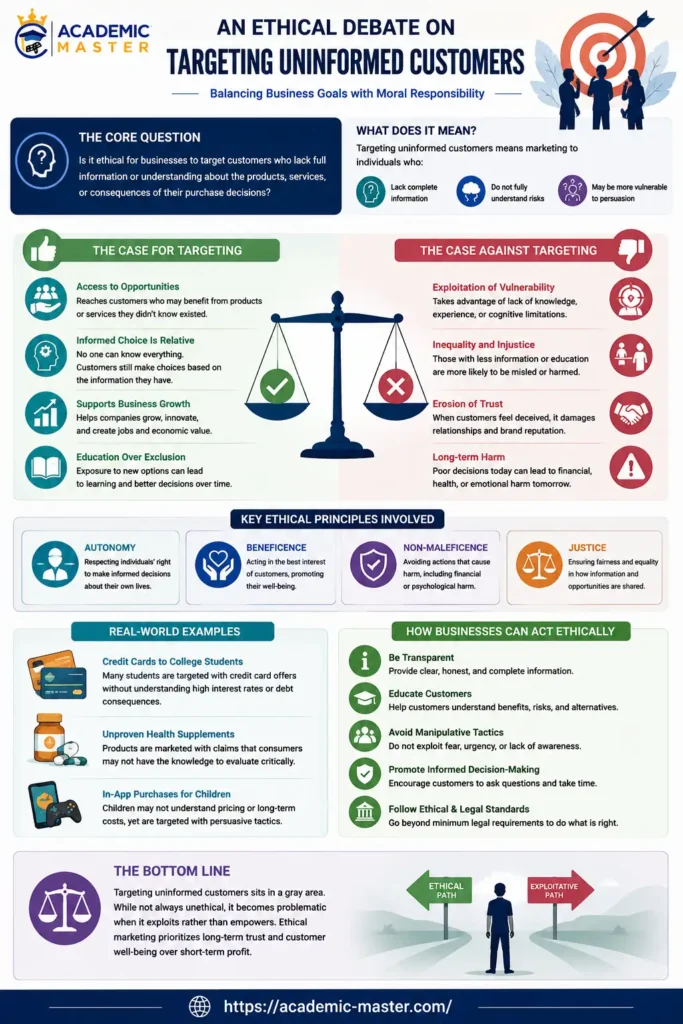
In today’s age of information, marketing has become more competitive and complex. Customers are exposed to advertisements through television, websites, social media, email, mobile applications, and online shopping platforms. Because of this, marketers must use distinctive promotional methods to attract attention and leave a lasting impression on consumers. One such method is targeting uninformed consumers. In my opinion, targeting uninformed consumers can be an ethical marketing practice when it is conducted with caution, honesty, transparency, and respect for consumer rights.
Targeting uninformed consumers means reaching out to people who may not have enough knowledge about a product, service, brand, or market option. These consumers may not understand product features, pricing differences, quality standards, or available alternatives. In many cases, they may depend heavily on marketing messages to guide their purchasing decisions. Because of this, marketers have a strong responsibility to provide accurate and useful information rather than exploit the lack of knowledge among such consumers.
Commercial Rights and the Introduction of New Products
Targeting uninformed consumers can be considered the right of marketers because it enables companies to introduce new brands in the market and reach a wider range of potential users. New businesses, especially small or emerging brands, often need to educate customers about their products. Without marketing, consumers may never learn about new options that could meet their needs better than existing products. Buehler and Schuett (2014) explain that uninformed consumers can influence market behavior, especially when quality standards and certification are involved. This shows that consumer knowledge plays an important role in market decisions and business success.
It is also important to inform customers because informed consumers are more likely to make sensible and responsible purchases. When people understand the differences between brands, prices, ingredients, quality, and usage, they can choose products that suit their needs and budget. For example, some consumers may buy expensive brand-name products simply because they believe famous brands are always better. However, research reported by BBC News (2014) suggests that uninformed consumers may waste money on high-end brand names when store brands could provide similar value. This example shows that lack of information can harm consumers financially.
From this perspective, targeting uninformed consumers is not unethical if the purpose is to educate them. Ethical marketing should help consumers understand what they are buying. It should provide clear information about product benefits, limitations, price, quality, safety, and proper use. When companies provide honest information, consumers become more confident and satisfied. This can help build trust between the company and the customer.
Consumer Education and the Value of Targeted Communication
Target marketing can also enable companies to provide individual support to uninformed consumers. For example, a company selling technical products, health-related items, financial services, or educational tools may need to explain how the product works and how it should be used. Some customers may not fully understand the product at first, and targeted communication can help them make better decisions. This improves customer satisfaction because consumers feel supported rather than confused.
Another advantage of educating uninformed consumers is that it can reduce complaints. When customers clearly understand product functions, instructions, benefits, and limitations, they are less likely to misuse the product or develop unrealistic expectations. Educated customers are usually more skilled in using products correctly. This helps both the consumer and the company. Consumers receive better value, and companies reduce the cost of handling complaints, returns, and dissatisfaction.
Companies can ethically target uninformed consumers through several useful methods. They can provide hands-on experiences, organize workshops, publish guides, share useful content, offer demonstrations, and provide customer support. Okeke (2017) argues that educating customers has many benefits because it improves understanding and strengthens customer relationships. For example, a company selling skincare products can educate customers about skin types and correct product usage. A company selling technology can provide tutorials and demonstrations. A bank can educate customers about safe financial choices. These methods are ethical because they empower consumers instead of manipulating them.
Manipulation, Deception, and the Ethical Limits of Marketing
However, it is important to recognize that targeting uninformed consumers can become unethical if companies use deception, pressure, or manipulation. The problem is not target marketing itself but the intention and methods used by marketers. If a company deliberately hides important information, exaggerates product benefits, uses confusing language, or creates false fear, then the practice becomes unethical. Uninformed consumers are more vulnerable because they may not have the knowledge needed to identify misleading claims.
One major unethical practice is deceptive advertising. This occurs when companies present false or misleading information to persuade customers to buy a product. For example, a company may claim that a product is healthier, safer, or more effective than it actually is. Such practices violate consumer trust and may cause financial or physical harm. Ethical marketing must avoid false promises and ensure that claims are supported by evidence.
Another unethical practice is targeting vulnerable groups unfairly. Marketers must be careful when approaching minors, elderly people, people with limited education, or individuals with certain beliefs or emotional vulnerabilities. These groups may not always be able to evaluate marketing messages critically. For instance, targeting children with unhealthy food advertisements or pressuring elderly consumers to buy unnecessary financial products can be considered unethical. Companies should avoid exploiting weakness, fear, or lack of awareness.
Transparency, Trust, and Responsible Targeting Practices
Transparency is therefore essential in ethical target marketing. Companies should clearly explain what they are selling, how much it costs, what benefits it provides, and what risks or limitations may exist. Transparency creates trust and helps consumers make informed choices. In the long term, ethical marketing is more beneficial for companies because satisfied and informed customers are more likely to remain loyal.
In my view, targeting uninformed consumers should not be rejected completely. Instead, it should be regulated by ethical principles. Businesses have the right to promote their products and reach new customers, but they also have the duty to protect consumers from manipulation. The goal should be education, not exploitation. When marketing helps customers understand their options and make better decisions, it becomes a positive and ethical practice.
In conclusion, targeting uninformed consumers can be ethical when it is carried out with honesty, caution, and responsibility. It allows companies to introduce new products, educate customers, increase satisfaction, and build long-term loyalty. However, companies must avoid unethical practices such as deceptive advertising, manipulation, and targeting vulnerable groups unfairly. The ethical value of target marketing depends on whether it empowers consumers or exploits their lack of knowledge. Therefore, companies should use marketing as a tool for information, transparency, and customer support rather than manipulation.
References
BBC News. (2014). Study: Uninformed consumers waste money on name brands. https://www.bbc.com/news/blogs-echochambers-28451696
Buehler, B., & Schuett, F. (2014). Certification and minimum quality standards when some consumers are uninformed. European Economic Review, 70, 493–511.
Okeke, K. (2017). Educating your customers: The benefits & how to achieve it. https://customerthink.com/educating-your-customers-the-benefits-how-to-achieve-it/
Cite This Work
To export a reference to this article please select a referencing stye below:

Academic Master Education Team is a group of academic editors and subject specialists responsible for producing structured, research-backed essays across multiple disciplines. Each article is developed following Academic Master’s Editorial Policy and supported by credible academic references. The team ensures clarity, citation accuracy, and adherence to ethical academic writing standards
Content reviewed under Academic Master Editorial Policy.



