
Introduction
The title “Physician-Assisted Suicide should be Legal” frames a contested end-of-life policy proposition rather than a settled medical conclusion. The debate concerns whether a physician should be permitted, under defined legal conditions, to provide a mentally capable patient with medication that the patient may choose to self-administer to end life. Supporters emphasize autonomy, relief from intolerable suffering, and the ability of terminally ill adults to control the manner and timing of death. Opponents emphasize the physician’s healing role, the possibility of coercion, unequal access to high-quality care, disability-related discrimination, prognostic uncertainty, and the risk that economic pressures may influence decisions. Both perspectives place weight on dignity, compassion, informed consent, and careful end-of-life care but interpret those values differently. The legal question is therefore not simply whether suffering exists; it is whether a regulated form of physician assistance can protect patient choice without undermining professional obligations or exposing vulnerable patients to unacceptable risk. Current U.S. practice varies by jurisdiction, so ethical arguments must be distinguished from the specific safeguards contained in each law.
Terminology and the Oregon Model
Physician-assisted suicide, also called physician-assisted dying or medical aid in dying in some jurisdictions, differs from euthanasia because the patient performs the final life-ending act by voluntarily ingesting prescribed medication. It also differs from withdrawing life-sustaining treatment, where death results from the underlying disease after a patient refuses or discontinues an intervention. Oregon’s Death with Dignity Act provides a long-running U.S. example of a narrow statutory model. Eligibility is limited to adults who can make and communicate healthcare decisions and who have a terminal illness expected to lead to death within six months. The attending and consulting clinicians must confirm diagnosis, prognosis, and decision-making capacity, and a mental-health evaluation is required when impaired judgment is suspected. Patients must be informed about alternatives, including hospice, pain management, and comfort care. The patient controls whether the medication is ever taken, which means receiving a prescription does not necessarily result in an assisted death (Oregon Health Authority, 2026).
Arguments Supporting Legal Authorization
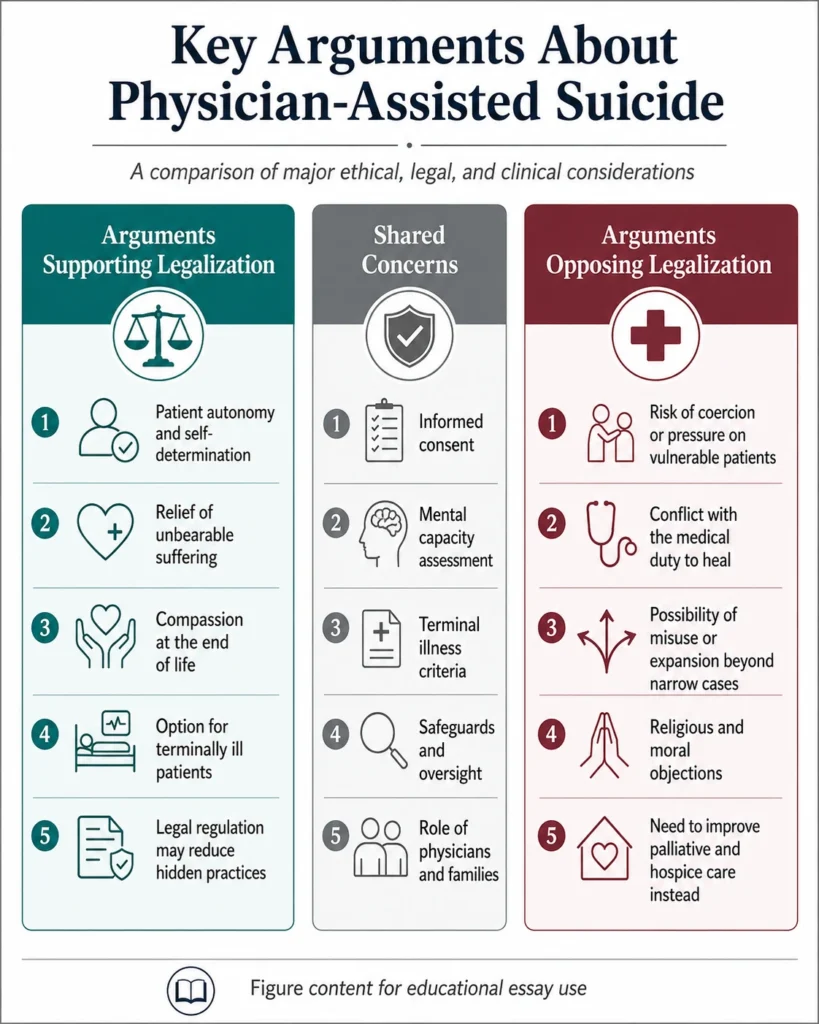
The principal argument supporting authorization is patient autonomy. Competent adults may already refuse chemotherapy, ventilation, dialysis, artificial nutrition, surgery, or other life-sustaining treatment even when refusal is expected to shorten life. Supporters argue that a terminally ill patient who has been fully informed and who consistently regards further decline as intolerable should have some authority over the manner of dying as well. Suffering may involve pain, but it can also include breathlessness, weakness, loss of bodily control, dependence, inability to communicate, or loss of activities that gave life meaning. Oregon reporting has repeatedly shown that concerns about autonomy, participation in enjoyable activities, and dignity are common among participants, illustrating why the debate cannot be reduced to whether analgesics are available. From this perspective, carefully regulated assisted death may function as a last-resort option for a small group of capable terminally ill adults who consider the remaining dying process unacceptable despite supportive care.
Supporters also argue that legalization can create transparency and oversight that are unavailable when desperate patients or families act outside the healthcare system. A statute can specify eligibility, documentation, consultation, reporting, voluntariness, and penalties for coercion. It can require clinicians to discuss hospice and symptom management, allow the patient to withdraw at any time, and protect clinicians who object to participation according to applicable law. Public reporting can also reveal how often prescriptions are issued, how many are used, what diagnoses are involved, and whether demographic patterns change. Oregon’s 2025 data summary reported 637 prescriptions and, by the reporting date, 400 deaths following ingestion of prescribed medication during 2025, including some prescriptions written in earlier years (Oregon Health Authority, 2026). Those figures describe use of the law; they do not by themselves establish that the policy is ethically justified or free from hidden pressure. They are evidence for evaluating how a regulated system functions in practice.
Arguments Against Legal Authorization
Opponents question whether providing life-ending medication is compatible with the physician’s professional role. The American Medical Association’s Code of Medical Ethics maintains an opposition to physician-assisted suicide and describes a moral tension between the desire to relieve suffering and the profession’s role in healing and care (American Medical Association, 2026). The American College of Physicians has also opposed legalization, emphasizing palliative care, communication, and protection of the patient-physician relationship (Snyder Sulmasy & Mueller, 2017). Critics argue that the availability of a life-ending prescription can alter the meaning of medical recommendations and may create uncertainty about whether continued treatment, disability support, home assistance, or expensive care will be offered with equal commitment. They also note that prognosis is imperfect, depression may affect judgment, and social conditions can shape choices. A request that appears autonomous may be influenced by loneliness, family burden, inadequate care, financial pressure, or a society that undervalues lives with severe disability. These concerns focus on the conditions under which choice is made, not simply the existence of formal consent.
Economic inequality and unequal access to palliative care make the vulnerability question especially important. A patient choosing between excellent home support and assisted dying is situated differently from one facing untreated pain, housing instability, caregiver exhaustion, or unaffordable services. Disability-rights critics warn that dependence on others is sometimes described as inherently undignified even though many people with serious disabilities report meaningful quality of life. Legal safeguards can require private interviews, capacity assessment, independent confirmation, and documentation, but no procedure can make social inequality disappear. Conversely, evidence that most Oregon participants were enrolled in hospice shows that assisted dying and palliative care are not always alternatives selected because comfort care was unavailable. The ethical dispute therefore persists even under relatively strong safeguards. Opponents see a line medicine should not cross, while supporters argue that denying a persistent request can itself disregard the values of a capable person approaching death. Neither position can be reduced to indifference toward suffering.
Palliative Care, Safeguards, and Evidence
High-quality palliative and hospice care is central to both sides of the debate because a request to hasten death should not arise from untreated symptoms or lack of support that could reasonably be corrected. Palliative care can address pain, breathlessness, anxiety, family communication, spiritual distress, and treatment goals, while hospice provides specialized end-of-life services when cure is no longer the primary objective. Gert, Culver, and Clouser (1998) emphasize alternatives that relieve suffering without requiring direct participation in death, whereas supporters of legalization note that some patients continue to experience unacceptable loss of function or autonomy even while receiving hospice. The current Oregon Death with Dignity Act illustrates the importance of continuous monitoring because annual data depend heavily on reports from participating clinicians and cannot capture every family interaction, psychological influence, or unrecorded complication. Evidence from such systems should therefore be used to test claims, identify possible safeguards, and examine outcomes rather than to assume in advance that regulation either eliminates or proves every concern.
Conclusion
The policy debate over physician-assisted suicide turns on competing interpretations of autonomy, compassion, professional duty, vulnerability, and the role of medicine near the end of life. Supporters emphasize the ability of mentally capable terminally ill adults to make a persistent and informed choice when suffering or loss of function becomes unacceptable to them. Opponents emphasize the physician’s healing role, uncertainty in prognosis and capacity, unequal access to supportive care, and the possibility that social or economic pressure may influence vulnerable patients. Oregon’s experience demonstrates how a regulated model can define eligibility, require consultation, preserve patient self-administration, and generate public data, while professional organizations such as the AMA and ACP continue to articulate substantive ethical objections. The evidence therefore informs the debate without determining one universally accepted conclusion. Any legal framework addressing this issue must be evaluated according to its actual eligibility rules, protections against coercion, access to palliative care, reporting quality, conscientious-objection provisions, and outcomes for patients whose choices may be shaped by illness, disability, poverty, or dependence.
References
American Medical Association. (2026). Code of Medical Ethics Opinion 5.7: Physician-assisted suicide.
Gert, B., Culver, C. M., & Clouser, K. D. (1998). An alternative to physician-assisted suicide: A conceptual and moral analysis. In M. P. Battin, R. Rhodes, & A. Silvers (Eds.), Physician assisted suicide: Expanding the debate (pp. 182–202). Routledge.
Oregon Health Authority. (2026). Oregon Death with Dignity Act 2025 data summary. Public Health Division.
Snyder Sulmasy, L., & Mueller, P. S. (2017). Ethics and the legalization of physician-assisted suicide: An American College of Physicians position paper. Annals of Internal Medicine, 167(8), 576–578. doi:10.7326/M17-0938
Cite This Work
To export a reference to this article please select a referencing stye below:

Academic Master Education Team is a group of academic editors and subject specialists responsible for producing structured, research-backed essays across multiple disciplines. Each article is developed following Academic Master’s Editorial Policy and supported by credible academic references. The team ensures clarity, citation accuracy, and adherence to ethical academic writing standards
Content reviewed under Academic Master Editorial Policy.





