
Introduction
Martin Scorsese’s Raging Bull (1980) is structured around boxing, yet its deeper subject is the relationship between violence, jealousy, masculinity, shame, and self-destruction. Adapted from Jake LaMotta’s autobiography, the film stars Robert De Niro as LaMotta, Joe Pesci as his brother Joey, and Cathy Moriarty as Vickie, with cinematography by Michael Chapman and editing by Thelma Schoonmaker (American Film Institute, n.d.). The narrative follows Jake from professional ambition and championship success to domestic collapse, estrangement, imprisonment, and later work as a nightclub performer. Scorsese avoids the conventional sports-film pattern in which discipline produces moral improvement. Jake’s physical toughness helps him in the ring but becomes destructive when he treats intimate relationships as contests that must be controlled. The film’s black-and-white photography, shifting camera speeds, subjective sound, fragmented editing, and tight interiors turn Jake’s psychological instability into cinematic form. Its achievement lies in making viewers understand the fears beneath his behavior without asking them to excuse the harm he causes.
Jake LaMotta as an Antihero
Jake LaMotta is compelling because the qualities that make him formidable as a boxer are inseparable from the traits that damage his private life. He can absorb punishment, resist intimidation, and continue fighting under extraordinary physical pressure, but he experiences vulnerability, dependence, and uncertainty as threats to his identity. His jealousy toward Vickie develops less from evidence than from insecurity and a need to control how other people look at, speak to, and think about her. He eventually extends the same suspicion to Joey, who has been his manager, advocate, and closest companion. The result is a tragic reversal: the man who believes domination protects him destroys the relationships that offer loyalty and stability. De Niro’s performance emphasizes this contradiction through posture, silence, repeated questions, sudden eruptions, and later physical transformation. Jake is not presented as a heroic sufferer or a simple villain. Viewers can recognize loneliness, humiliation, and fear in him while remaining responsible for seeing his abuse clearly. The film’s moral complexity depends on holding those two perceptions together rather than allowing psychological explanation to become exoneration.
Violence Inside and Outside the Ring
The contrast between regulated boxing and domestic violence organizes much of the film’s meaning. Inside the ring, aggression operates within rules, rounds, referees, judges, ropes, and public spectatorship. Jake understands this environment because pain can be converted into achievement, status, and applause. Outside the ring, the same emotional logic becomes destructive because marriage and family require trust, patience, communication, and acceptance of other people’s independence. Jake repeatedly treats conversation as confrontation and affection as evidence that someone can betray him. Scorsese does not argue that boxing causes his abuse; rather, boxing is the one setting in which Jake’s reliance on force appears socially intelligible. The disturbing irony is that he often seems most controlled when openly fighting another man and most dangerous in ordinary domestic situations. His final major fight with Sugar Ray Robinson intensifies this pattern because Jake’s willingness to remain standing appears simultaneously impressive and pathological. Endurance becomes a way of proving worth through suffering, suggesting that Jake understands pain more easily than intimacy and can accept physical punishment more readily than emotional self-examination.
Black-and-White Cinematography, Camera, and Editing
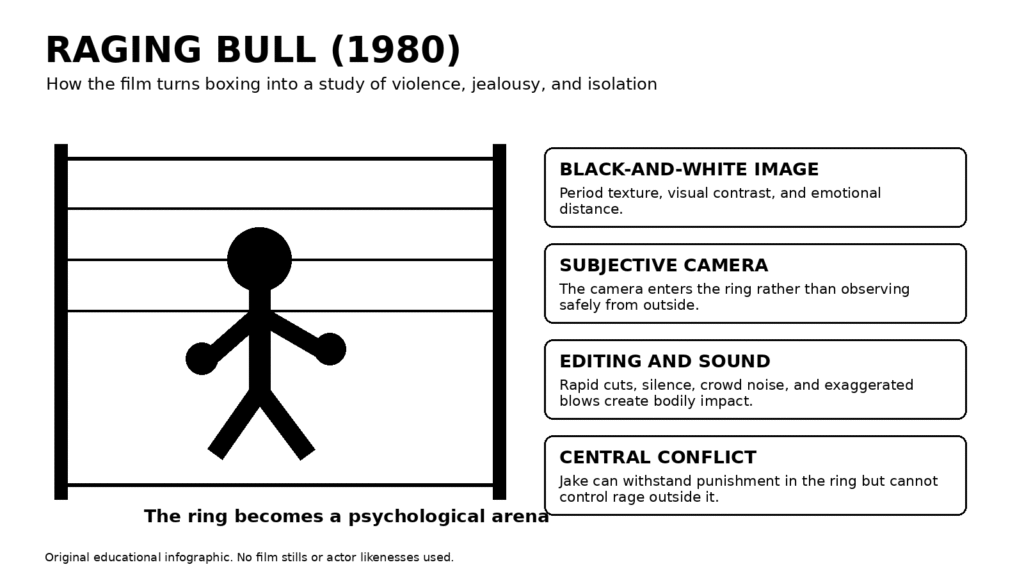
Michael Chapman’s black-and-white cinematography gives Raging Bull historical texture while also making the film resemble memory rather than neutral documentation. High contrast turns sweat, smoke, faces, ropes, and flashbulbs into graphic elements, and the boxing ring often seems detached from ordinary space. Scorsese’s camera does not observe fights from one stable ringside position; it moves beside the fighters, circles them, rushes forward, slows time, changes apparent scale, and sometimes transforms the ring into an almost expressionistic mental landscape. Thelma Schoonmaker’s editing reinforces this subjectivity by breaking impacts into fragments of gloves, faces, ropes, feet, blood, and flashes rather than always showing complete actions. Slow motion can enlarge a glance or gesture until it resembles the suspicious attention through which Jake interprets other people. Quieter scenes are edited differently, allowing pauses to become uncomfortable and giving the possibility of violence time to accumulate. The Academy recognized Schoonmaker with the Oscar for film editing, while De Niro won best actor and the film received additional major nominations (Academy of Motion Picture Arts and Sciences, n.d.).
Sound, Masculinity, and the Psychology of Control
Sound makes the boxing sequences feel less like sports coverage and more like subjective physical experience. Punches are exaggerated through layered effects, while crowd noise, bells, breathing, camera flashes, and sudden silence move the viewer between public spectacle and Jake’s private perception. At moments, the disappearance or distortion of expected sound isolates him even while thousands of spectators are present. This design parallels the film’s treatment of masculinity. Jake believes strength requires physical dominance, sexual certainty, emotional concealment, and control over the people around him. Because he cannot acknowledge fear or insecurity directly, those emotions appear as accusation and aggression. Vickie’s autonomy becomes threatening, and Joey’s independent judgment eventually looks like betrayal. The film refuses to romanticize these patterns: Vickie’s fear and exhaustion reveal the domestic cost of Jake’s obsession, while Joey’s eventual withdrawal shows that loyalty has limits. Masculine toughness becomes a prison because Jake has developed an identity organized around the avoidance of vulnerability. He can withstand blows from opponents but cannot tolerate the ordinary ambiguity involved in loving people he cannot completely control.
Transformation, Memory, and the Question of Redemption
Robert De Niro’s physical transformation distinguishes the younger boxer from the older nightclub performer, but the performance also preserves psychological continuity between them. The younger Jake is compact, watchful, and physically prepared for confrontation; the older Jake is heavier, slower, and dependent on jokes, performance routines, alcohol, and reminiscence. Both versions seek an audience. In the ring, public attention validates toughness, while the nightclub offers another stage on which he can turn pain into performance. Near the end, Jake rehearses a speech from On the Waterfront before a mirror, invoking a story about lost opportunity and blame. The moment suggests self-recognition but does not prove complete repentance. Jake has been affected by boxing corruption and his social environment, yet many of his most devastating losses come from choices he made toward Vickie and Joey. The mirror therefore remains ambiguous: it can represent a beginning of self-examination or another performance through which he borrows someone else’s language instead of directly apologizing. Scorsese resists a simple redemption arc and leaves moral understanding incomplete.
Critical Evaluation
Raging Bull is difficult to experience as conventional entertainment because its protagonist repeatedly harms the people closest to him, but that discomfort is central to the film’s design. Its strongest achievement is the unity between character and technique. Cinematography transforms the ring into an unstable psychological space, editing turns violence into fragmented impact, sound shifts between public noise and interior isolation, and performance makes suspicion visible before violence begins. The black-and-white imagery also separates the film from brightly colored sports spectacle and helps connect it to period photographs, news footage, and remembered family images. A limitation is that the story remains so closely tied to Jake’s consciousness that Vickie and Joey receive less independent interior development than their importance deserves. Moriarty and Pesci nevertheless prevent them from becoming flat functions of Jake’s psychology by giving both characters recognizable frustration, loyalty, confidence, fear, and limits. The film’s ultimate subject is not boxing success but the human cost of constructing identity around domination and treating vulnerability as defeat. Athletic achievement cannot compensate for emotional and moral collapse.
Conclusion
Raging Bull remains an important American film because it overturns the expected relationship between sporting victory and personal growth. Jake LaMotta can become a champion without becoming more capable of trust, self-knowledge, or restraint. His ability to endure punishment is both his greatest athletic strength and a clue to his deeper problem: he repeatedly converts suffering into proof of worth while refusing the emotional vulnerability required by intimate relationships. Scorsese expresses this conflict through an unusual combination of realistic period detail and highly formalized fight sequences. Black-and-white photography, moving cameras, subjective sound, abrupt changes in tempo, and Schoonmaker’s editing make the ring feel like an extension of Jake’s unstable inner world. The film neither excuses him because he suffers nor reduces him to a monster whose behavior requires no explanation. Instead, it asks viewers to recognize insecurity, ambition, jealousy, and loneliness while still holding him accountable for violence. That combination of psychological understanding and moral responsibility gives the film its continuing force beyond the conventions of the boxing genre.
References
Academy of Motion Picture Arts and Sciences. (n.d.). The 53rd Academy Awards: 1981.
American Film Institute. (n.d.). Raging Bull (1980). AFI Catalog of Feature Films.
Bernard, J. (n.d.). Raging Bull. National Film Preservation Board, Library of Congress.
Ehrenstein, D. (1990, December 2). Raging Bull. The Criterion Collection.
Lustgarten, A. (2022, August 25). 10 things I learned: Raging Bull. The Criterion Collection.
Robertson, R. (2022, July 13). Raging Bull: American Minotaur. The Criterion Collection.
Scorsese, M. (Director). (1980). Raging Bull [Film]. Chartoff-Winkler Productions; United Artists.
Cite This Work
To export a reference to this article please select a referencing stye below:

Academic Master Education Team is a group of academic editors and subject specialists responsible for producing structured, research-backed essays across multiple disciplines. Each article is developed following Academic Master’s Editorial Policy and supported by credible academic references. The team ensures clarity, citation accuracy, and adherence to ethical academic writing standards
Content reviewed under Academic Master Editorial Policy.





