
Radiologic technology is a healthcare profession that allows medical teams to examine internal parts of the human body that cannot be evaluated through an ordinary physical examination alone. Imaging procedures can help reveal fractures, infections, abnormal growths, organ problems, and other conditions that may otherwise remain hidden. This ability to support the diagnosis of disease is one of the strongest reasons I want to become a radiologic technologist. I have developed a genuine interest in the medical field and want a career in which my work can contribute directly to patient care. I am also passionate about helping people and interacting with them during moments when they may feel frightened, uncomfortable, or uncertain. Radiologic technology combines this human responsibility with my interest in anatomy, science, and modern medical equipment. For me, the profession offers an opportunity to build a meaningful healthcare career while helping patients move closer to an accurate diagnosis and suitable treatment.
Understanding the Role of a Radiologic Technologist
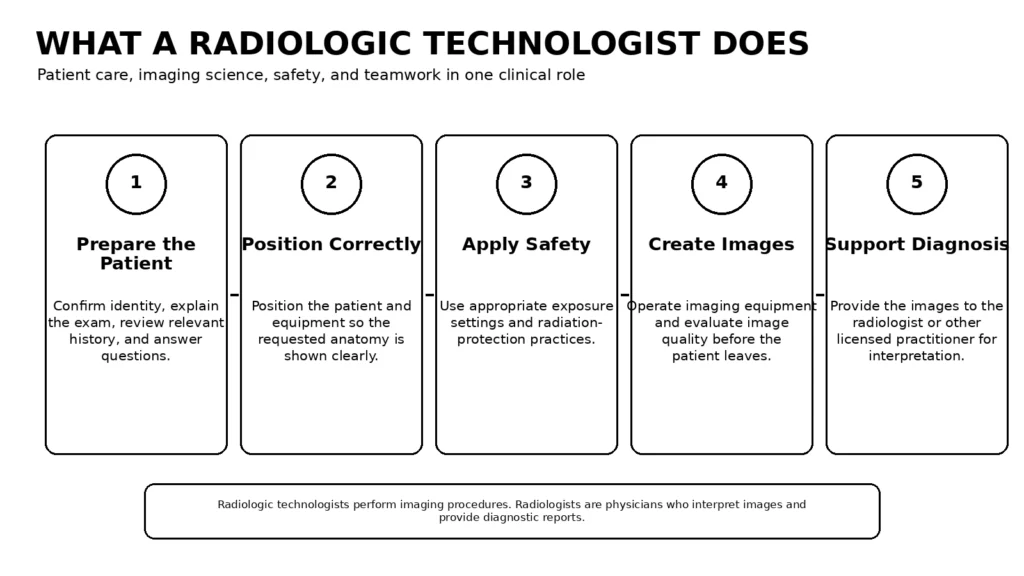
A radiologic technologist is a trained healthcare professional who performs diagnostic imaging examinations and produces images that physicians use when evaluating diseases and injuries. The technologist may operate X-ray or computed tomography equipment and may later pursue training in other imaging specialties. The role must not be confused with that of a radiologist, because a radiologist is a physician who interprets medical images and prepares diagnostic reports. The radiologic technologist prepares the patient, follows the physician’s imaging order, positions the body correctly, selects suitable technical settings, and evaluates whether the images are clear enough for interpretation. Technologists also maintain patient records, follow infection-control procedures, protect patients from unnecessary radiation, and communicate with members of the medical team. The American Society of Radiologic Technologists explains that correctly positioning patients and producing diagnostic-quality images are central responsibilities of the profession (American Society of Radiologic Technologists, n.d.-a). This means that the technologist plays an essential role before the radiologist can interpret the examination and assist with the diagnosis.
The original version of this essay described radiologic technology as an easy job that only requires equipment knowledge and communication skills. After learning more about the profession, I understand that this description is inaccurate because the role requires extensive education, clinical practice, concentration, and responsibility. A technologist must understand anatomy, pathology, radiation physics, image production, patient care, medical terminology, and safety procedures. The individual must also follow detailed instructions because an incorrectly positioned patient or unsuitable exposure setting may produce an image that cannot answer the physician’s question. Repeating an examination can delay care and may expose the patient to additional radiation, so accuracy is extremely important. Technologists may also work with injured, critically ill, elderly, or frightened patients who cannot easily move into the required position. The profession is therefore demanding, but that level of responsibility makes it more meaningful to me rather than discouraging me.
My Interest in Medical Imaging
The knowledge of X-rays and human anatomy used in radiologic technology is one of my main attractions to the medical field. I am interested in understanding how the bones, organs, tissues, and systems of the body work together. I also want to learn how disease or injury changes the normal appearance of these structures. Medical imaging allows healthcare professionals to examine the body without performing surgery simply to see what may be happening internally. This relationship between technology and anatomy makes radiologic technology intellectually interesting because every examination requires the technologist to connect scientific knowledge with a real patient. The work is not limited to pressing buttons on a machine, since the technologist must understand which anatomical structures need to appear and how the patient should be positioned to display them. Studying radiologic technology would therefore allow me to strengthen my knowledge of anatomy while applying it in a practical clinical environment.
I am also intrigued by the illnesses and injuries that affect the human body, as the original essay explains. However, the technologist does not independently determine the cause of a disease, prescribe a cure, or experiment with different conditions. Instead, the technologist follows established imaging protocols and creates accurate images that help a qualified physician evaluate the patient. I want to learn about different disorders so that I can understand why a particular image is being requested and provide the best possible examination within my professional role. This type of curiosity is important because medical technology and clinical practices continue to change. A competent technologist must be willing to study new equipment, updated safety standards, and improved imaging techniques throughout a career. My interest in disease is therefore not a desire to experiment on patients but a desire to understand medical problems and contribute responsibly to their diagnosis.
Helping Patients During Difficult Moments
One of the most important reasons I want to enter this profession is the opportunity to help patients directly. People who arrive in an imaging department may be in pain, worried about a possible diagnosis, or unfamiliar with the procedure they are about to undergo. A radiologic technologist may spend only a limited amount of time with each patient, but that short interaction can strongly influence the patient’s experience. Clear explanations can reduce anxiety, while a calm and respectful manner can help the person cooperate with positioning instructions. The technologist must listen carefully when a patient describes pain, limited movement, pregnancy concerns, previous reactions to contrast agents, or other relevant information. Good patient care also requires privacy, dignity, empathy, and sensitivity to different cultural and communication needs. The professional standards of medical imaging emphasize that technologists serve as an important link between patients, licensed practitioners, and the rest of the healthcare team (American Society of Radiologic Technologists, n.d.-b).
The original content states that this career is suitable for a social person who enjoys helping and interacting with people, and that idea remains central to my motivation. I believe my communication skills can help patients feel less alone during a stressful medical experience. At the same time, I understand that communication in healthcare involves more than friendly conversation. A technologist must provide clear instructions, confirm that a patient understands the procedure, respond professionally to questions, and recognize when information must be referred to a nurse, physician, or radiologist. The technologist should never give an unofficial diagnosis simply because an abnormality appears visible on an image. Patients may ask what the image shows, but professional boundaries require the technologist to explain that the interpreting physician will provide the results. Learning to combine warmth with professional judgment is one of the skills I hope to develop through education and supervised clinical experience.
Learning to Use Medical Imaging Equipment
Radiologic technology would expose me to medical imaging equipment and teach me how to operate it safely and effectively. The original essay correctly identifies this technical aspect as an important attraction to the profession. However, operating imaging equipment involves much more than knowing which button to press. A technologist must understand how equipment settings affect image quality and patient exposure. The individual must select settings that produce sufficient diagnostic information without using more ionizing radiation than necessary. The technologist must also inspect equipment, recognize technical problems, follow quality-control procedures, and report concerns according to institutional policy. Digital imaging systems have made image processing faster and more flexible, but they still require professional judgment because software cannot correct every positioning or exposure error. I look forward to developing the technical confidence needed to use these tools while remembering that every image represents a real patient rather than simply a technical exercise.
Radiation safety is another responsibility that makes the profession both challenging and important. X-ray and CT examinations use ionizing radiation, which can provide substantial medical benefits when a procedure is clinically justified and performed correctly. The United States Food and Drug Administration explains that the risk from appropriate medical imaging is generally small, but unnecessary exposure should still be minimized (U.S. Food and Drug Administration, 2023). Radiologic technologists contribute to this goal by following accurate examination orders, selecting suitable exposure factors, avoiding preventable repeat images, and applying established radiation-protection practices. They must also pay particular attention to patients whose age, pregnancy status, body size, or clinical condition may affect the examination. I want to learn these principles carefully because patient safety must remain more important than speed or convenience. The responsibility to use advanced technology safely is one reason I view radiologic technology as a serious professional career rather than an easy technical job.
Accuracy and Attention to Detail
A strong radiologic technologist must be highly attentive to detail because small errors can affect the usefulness of an examination. The patient’s identity, requested body part, side marker, position, exposure factors, and clinical history must all be checked carefully. If the wrong side is imaged or an important anatomical structure is excluded, the examination may need to be repeated. Accurate work can help the physician reach a timely diagnosis, while careless work may delay treatment or create avoidable risk. The United States Bureau of Labor Statistics identifies attention to detail, technical ability, interpersonal skills, mathematics, and physical stamina as important qualities for radiologic and MRI technologists (U.S. Bureau of Labor Statistics, 2025). These requirements appeal to me because I want a profession that demands both mental focus and practical skill. I am motivated to develop the discipline required to complete every examination with care, even during a busy shift.
Attention to detail also includes accurate documentation and respect for confidential medical information. Radiologic technologists may review a patient’s history, document procedure information, and record details related to contrast administration or safety screening. These records must be complete because other healthcare professionals may rely on them when making decisions. Confidential information should not be discussed casually or shared with unauthorized people. Technologists must also recognize their professional limits and request assistance when a situation falls outside their competence. Admitting uncertainty is not a weakness in healthcare because asking for help can prevent errors and protect a patient. I want to become a professional who values accuracy more than personal pride and who treats ethical conduct as part of every examination. This commitment would help me build the trust of patients, colleagues, and supervising physicians.
A Career That Combines Science and Human Interaction
Radiologic technology attracts me because it combines scientific knowledge with personal interaction. Some careers are strongly focused on technology but involve little direct contact with people, while others are highly social but do not satisfy my interest in anatomy and medical science. This profession brings both areas together in a balanced way. During one part of the examination, the technologist may need to calculate technical factors or evaluate image quality. A few moments later, the same person may need to reassure a nervous child, help an injured adult move safely, or explain why remaining still is important. The ability to move between technical and interpersonal responsibilities would keep the work meaningful and varied. It would also give me opportunities to continue developing both my scientific knowledge and my ability to care for people.
The original article describes the profession as suitable for someone adventurous and interested in the different diseases affecting the human body. I would express this idea by saying that I want a career that is varied, challenging, and filled with opportunities to learn. Imaging departments serve patients with different ages, injuries, illnesses, physical abilities, and emotional needs. Two examinations of the same body part may still require different approaches because no two patients are exactly alike. Emergency cases may require the technologist to work quickly, while difficult positioning may require patience and creativity within approved procedures. The work may also include hospital wards, operating rooms, emergency departments, outpatient clinics, or mobile imaging situations. This variety would allow me to face new professional challenges while continuing to build experience.
Professional Growth in Medical Imaging
The practice of radiologic technology would not only provide me with a profession but could also support my growth within the medical imaging field. Many people begin as radiographers and later pursue additional education or certification in computed tomography, magnetic resonance imaging, mammography, vascular imaging, cardiac interventional imaging, quality management, education, administration, or other disciplines. The American Registry of Radiologic Technologists explains that medical imaging professionals may work with X-ray, CT, MRI, fluoroscopy, sonography, nuclear medicine, or other specialized technologies depending on their education and credentials (American Registry of Radiologic Technologists, n.d.). These opportunities mean that the career does not have to remain limited to one type of examination. A technologist can continue learning and gradually move toward areas that match personal interests and abilities. I find this possibility encouraging because I want a career that allows long-term development rather than one that becomes professionally repetitive. Becoming a radiologic technologist could therefore serve as a strong foundation for a successful and competent career in healthcare.
Continuing education is especially important because imaging equipment, computer systems, patient-safety practices, and clinical expectations change over time. A person who completes an initial program cannot assume that no further learning will be necessary. Certification and professional standards commonly require technologists to maintain competence and continue their education. I am attracted to this expectation because I want to remain intellectually active and improve throughout my career. Learning new procedures could make me more useful to my employer and allow me to provide better care to patients. Professional development may also create opportunities to supervise students, manage an imaging department, participate in quality improvement, or teach future technologists. My goal is not simply to obtain a job but to become a dependable professional whose knowledge grows with experience. Radiologic technology provides a practical path toward that objective.
Career Stability and Financial Considerations
Personal fulfilment is my main motivation, but financial stability is also a reasonable consideration when selecting a career. The original essay mentions payment as one of the benefits of radiologic technology, although income should not be the only reason for entering a patient-care profession. According to the United States Bureau of Labor Statistics, the median annual wage for radiologic technologists and technicians was $77,660 in May 2024. The Bureau also projects continued demand for diagnostic imaging as the population ages and healthcare providers evaluate injuries and chronic conditions (U.S. Bureau of Labor Statistics, 2025). Actual earnings vary according to location, education, experience, specialty, employer, and work schedule. Evening, weekend, emergency, or specialized positions may involve different responsibilities and compensation. A stable income would allow me to support myself while working in an area I find personally meaningful.
The work also offers the fulfilment that comes from contributing to patient care, which may be more important over an entire career than salary alone. A clear image may help a physician confirm a fracture, identify an infection, evaluate a lung condition, or determine the next stage of treatment. The technologist may not always learn the final outcome, but the examination remains an important part of the patient’s care. Knowing that my accuracy and professionalism could help someone receive timely treatment would give purpose to my daily work. The role also allows professionals to witness improvements in technology and participate in a rapidly developing healthcare environment. At the same time, I recognize that the job can involve long periods of standing, lifting or turning patients, exposure to illness, emergency shifts, and emotionally difficult situations. Choosing the profession responsibly means accepting these challenges as well as appreciating its rewards.
My Commitment to Becoming a Competent Technologist
My desire to become a radiologic technologist is based on more than a general interest in hospitals or medical equipment. I want to build the scientific, technical, ethical, and communication skills required to perform the role properly. This means studying anatomy, pathology, radiation physics, positioning, patient care, image analysis, and safety with consistent effort. It also means learning from instructors, clinical supervisors, radiologists, nurses, and experienced technologists. I expect to make mistakes during training, but I must respond by accepting feedback and correcting them before independent practice. Patients deserve a technologist who is prepared, careful, respectful, and aware of professional limitations. My goal is to become that type of healthcare professional rather than someone who treats the position as a simple equipment-operating job.
I also understand that compassion must remain present even during busy or technically difficult examinations. A patient may be experiencing one of the most frightening days of life, while the examination is only one of many procedures for the technologist. I do not want routine work to make me forget the patient’s perspective. Explaining the procedure, protecting privacy, listening to concerns, and positioning the person as gently as possible can make a meaningful difference. My social nature and passion for helping people can support these responsibilities, but they must be strengthened by professional education and self-discipline. Technical skill without empathy may produce a correct image but a poor patient experience. Empathy without technical competence may feel supportive but cannot provide the diagnostic quality the patient needs. A successful radiologic technologist must bring both qualities together.
Conclusion
A radiologic technologist is a healthcare professional who uses radiographic knowledge, technical ability, patient-care skills, and safety principles to assist in the diagnosis of diseases and injuries. My interest in this profession comes from my passion for the medical field and my desire to help patients discover conditions that may threaten their health. The original reasons that attracted me to the career remain important, including my interest in X-rays, anatomy, diseases, medical tools, communication, professional growth, payment, and personal fulfilment. However, I now understand more clearly that the work is not easy and does not involve independently diagnosing illnesses or simply operating equipment. It requires formal preparation, careful positioning, radiation protection, accurate documentation, ethical judgment, and cooperation with radiologists and other healthcare professionals. This combination of science, technology, responsibility, and human interaction makes the career especially suitable for me. I want to become a radiologic technologist because the profession would allow me to continue learning while making a practical contribution to the diagnosis and care of patients.
References
American Registry of Radiologic Technologists. (n.d.). What do radiologic technologists do?
American Society of Radiologic Technologists. (n.d.-a). Careers in radiologic technology.
American Society of Radiologic Technologists. (n.d.-b). The ASRT practice standards for medical imaging and radiation therapy.
U.S. Bureau of Labor Statistics. (2025). Radiologic and MRI technologists. Occupational Outlook Handbook.
U.S. Food and Drug Administration. (2023). Medical X-ray imaging.
:::
Cite This Work
To export a reference to this article please select a referencing stye below:

Academic Master Education Team is a group of academic editors and subject specialists responsible for producing structured, research-backed essays across multiple disciplines. Each article is developed following Academic Master’s Editorial Policy and supported by credible academic references. The team ensures clarity, citation accuracy, and adherence to ethical academic writing standards
Content reviewed under Academic Master Editorial Policy.




