
Setting the Exposure Index
Exposure Index, commonly abbreviated as EI, is an important feedback indicator used in digital radiography. It helps the radiographer evaluate whether an adequate amount of radiation has reached the image receptor. In digital imaging, the image can often be processed to appear acceptable even when the exposure is too high or too low. For this reason, EI is useful because it provides numerical feedback about detector exposure and helps the radiographer judge whether the image was produced within the correct exposure range (American Association of Physicists in Medicine, 2009; International Electrotechnical Commission, 2008).
EI is not the same as patient dose. Instead, it reflects the amount of radiation incident on the detector after exposure. When the detector receives too little radiation, image noise increases and the diagnostic quality of the image may decrease. When the detector receives too much radiation, the image may look clean, but the patient may have received more radiation than necessary. Therefore, the goal is not simply to increase EI but to keep it within the recommended range for the body part and projection being examined (Seibert & Morin, 2011).
Is the EI Elevated or Decreased From Normal?
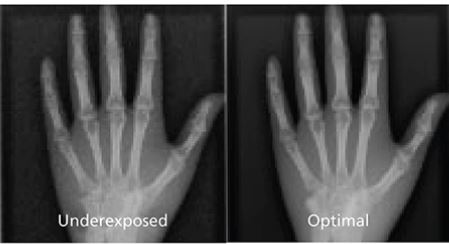
In this case, the posteroanterior image of the hand appears to be underexposed. Therefore, the exposure index is lower than the expected or normal range for this projection. A low EI generally means that an insufficient number of x-ray photons reached the detector. As a result, the image may have poor signal quality and may not provide enough diagnostic information.
For a hand radiograph, proper exposure is important because the image must clearly demonstrate fine bony detail, joint spaces, soft tissue outlines, and cortical margins. If the EI is too low, these structures may not be seen clearly, and the image may need to be repeated according to departmental policy.
What Indicators Support the Out-of-Range EI?
The main indicator of a low EI is increased image noise, also known as quantum mottle. Quantum mottle occurs when too few x-ray photons reach the detector, causing the image to appear grainy or speckled. This lowers the signal-to-noise ratio and makes the image less useful for diagnosis.
In the underexposed posteroanterior hand image, the following signs may support the out-of-range EI:
- The image may appear noisy or grainy because of quantum mottle.
- The anatomical details may appear poorly defined.
- The cortical margins of the bones may not be clearly visible.
- Fine trabecular patterns may be difficult to identify.
- The soft tissue detail may be reduced.
- The overall diagnostic quality may be limited.
Although the image may also appear light or low in contrast, brightness alone is not always a reliable sign in digital radiography. Digital systems can adjust image brightness and contrast through processing. Therefore, noise level and loss of anatomical detail are more reliable indicators of underexposure (Radiopaedia, 2019).
What Does High or Low EI Mean?
A low EI means that the detector received less radiation than required for an optimal image. This usually results in a lower signal-to-noise ratio and more quantum mottle. In practical terms, a low EI suggests underexposure. Underexposed images may lack sufficient detail and may be unsuitable for diagnosis, especially when fine structures such as bones of the hand need to be evaluated.
A high EI means that the detector received more radiation than required. A high EI may produce an image with less noise and clearer detail, but it may also indicate unnecessary radiation exposure to the patient. This is a concern in digital radiography because overexposed images may still look acceptable after processing. This problem is sometimes called exposure creep, where exposure factors gradually increase over time because the image appears visually acceptable.
The best practice is to maintain EI close to the target exposure index for the specific examination. The target exposure index is the expected EI value for a particular body part and projection. The deviation index, or DI, indicates how far the actual EI is from the target EI. A negative DI generally suggests underexposure, while a positive DI suggests overexposure.
What Was Done Wrong?
The most likely error was that the exposure factors were too low for the hand image. This means that the selected technical factors did not allow enough x-ray photons to reach the detector. The mAs may have been too low, the exposure technique may not have matched the patient’s hand size, or the selected exposure chart may not have been followed correctly.
Another possible issue is improper use of the target exposure index and deviation index. If the actual EI is far below the target EI, the image is underexposed. This difference should alert the radiographer that the exposure factors need adjustment.
Positioning and collimation should also be reviewed. Poor positioning, excessive collimation error, grid misuse, or incorrect detector selection can affect image quality and EI feedback. However, in this case, the main problem appears to be insufficient exposure rather than positioning alone.
How Will the Problem Be Fixed?
The image can be improved by adjusting the exposure factors according to the department’s technique chart and the digital radiography system’s recommended EI range. For a low-EI hand radiograph, the radiographer may need to increase the exposure, usually by adjusting mAs while maintaining appropriate kVp for the examination.
The following corrective steps may be used:
- The standard exposure chart for a posteroanterior hand radiograph should be reviewed.
- The mAs should be adjusted to provide adequate detector exposure.
- The kVp should remain appropriate for hand imaging to maintain proper contrast and penetration.
- The patient’s hand should be positioned correctly against the detector.
- Collimation should include the required anatomy without unnecessary exposure.
- The EI, target EI, and DI should be reviewed after exposure.
- The radiographer should follow departmental protocol before repeating any image.
Any repeat exposure must be justified. The goal is to obtain a diagnostic image while keeping radiation exposure as low as reasonably achievable. The correction should improve image quality without unnecessarily increasing patient dose.
Will Any Additional Changes Be Made?
Yes, additional changes may be necessary to prevent the same error from happening again. The digital radiography vendor’s instruction manual should be reviewed because EI values and exposure indicators may vary between systems. Different manufacturers may use different naming systems or scales, so radiographers must understand how their specific equipment reports EI and DI.
It would also be useful to compare the image with the department’s acceptable EI range for a PA hand projection. If repeated underexposure occurs, the department may need to review its technique chart, detector calibration, image processing settings, or staff training. Consistent monitoring of EI and DI helps improve image quality and supports radiation safety.
Image Suggestion
For the website or assignment, an appropriate image example would be a posteroanterior hand radiograph that demonstrates underexposure. The image should show visible quantum mottle, reduced fine bony detail, unclear cortical margins, and limited diagnostic quality.
Suggested caption:
“Example of an underexposed PA hand radiograph showing low EI, increased quantum mottle, and reduced anatomical detail.”
Conclusion
Exposure Index is an essential tool in digital radiography because it helps evaluate whether enough radiation reached the detector to produce a diagnostic image. In this case, the PA hand image was underexposed, meaning the EI was lower than expected. The main signs of underexposure include quantum mottle, low signal-to-noise ratio, poor anatomical detail, and reduced diagnostic quality. To correct the problem, the radiographer should review the exposure chart, adjust technical factors appropriately, and check the EI, target EI, and deviation index after exposure. Proper use of EI helps produce high-quality images while supporting patient safety and radiation protection.
References
American Association of Physicists in Medicine. (2009). An Exposure Indicator for Digital Radiography: AAPM Task Group 116 Report.
International Electrotechnical Commission. (2008). IEC 62494-1: Medical Electrical Equipment—Exposure Index of Digital X-Ray Imaging Systems.
Radiopaedia. (2019). Optimal Exposure in Digital Radiography.
Seibert, J. A., & Morin, R. L. (2011). The standardized exposure index for digital radiography: An opportunity for optimization of radiation dose to the pediatric population. Pediatric Radiology, 41, 573–581.
Cite This Work
To export a reference to this article please select a referencing stye below:

Academic Master Education Team is a group of academic editors and subject specialists responsible for producing structured, research-backed essays across multiple disciplines. Each article is developed following Academic Master’s Editorial Policy and supported by credible academic references. The team ensures clarity, citation accuracy, and adherence to ethical academic writing standards
Content reviewed under Academic Master Editorial Policy.



